

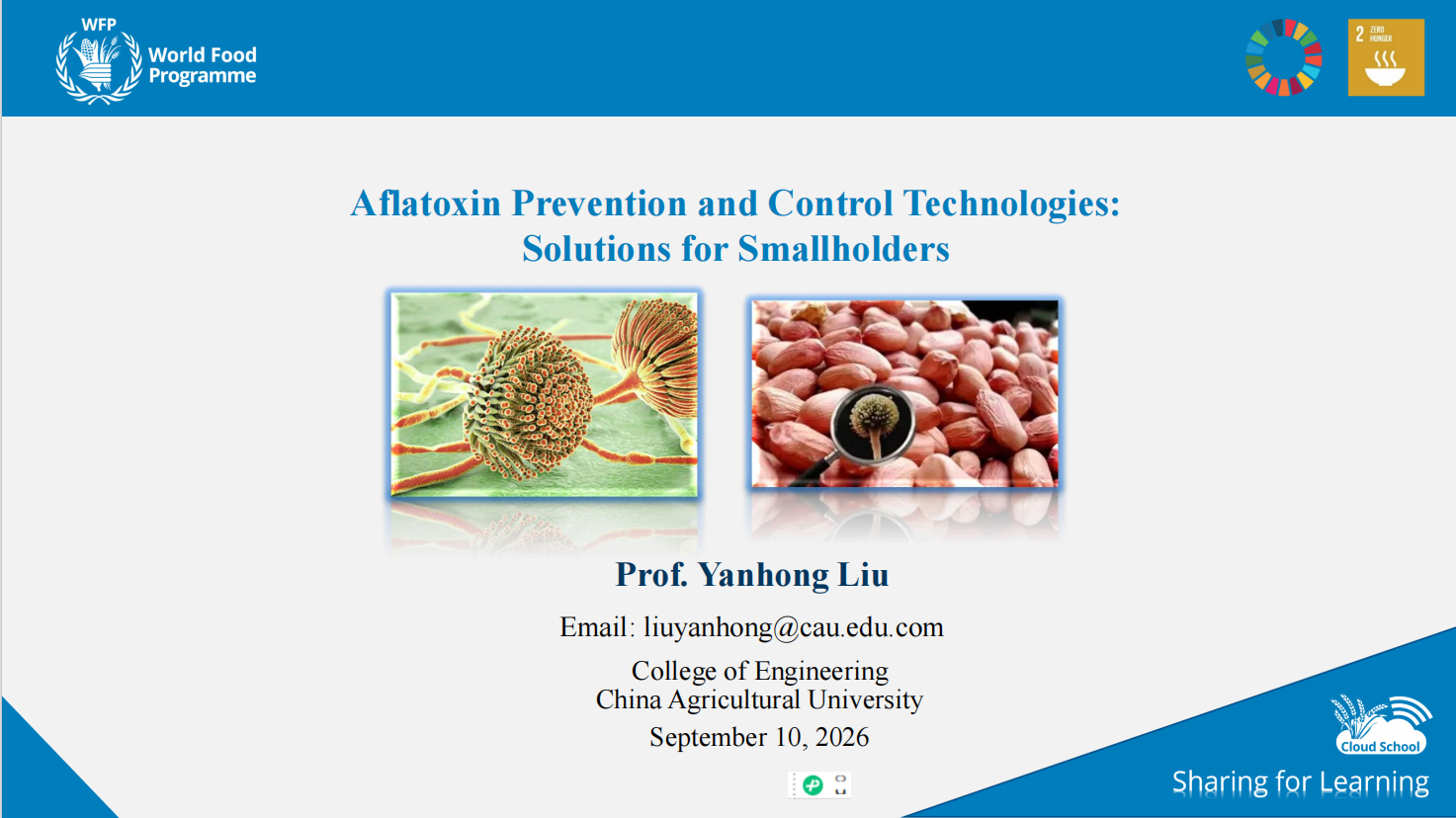
The WFP Centre of Excellence for Rural Transformation (WFP China COE) organized an online training on Post-harvest Loss Management Technologies for Smallholders from September 1 to 10, 2026. Presented by Professor Liu Yanhong from China Agricultural University, the four-session program provided a platform for knowledge exchange and experience sharing among developing countries. It aimed to equip participants with practical tools, operational models, and proven technologies for effective post-harvest management, thereby contributing to improved food security and agricultural resilience. The four sessions are as follows:
Session I: Fruits and Vegetables Preservation and Storage Technologies
Session II: Fruit and Vegetable Drying Technologies
Session III: Emergency Drying of Grains and Oils
Session IV: Aflatoxin Prevention and Control Technologies: Solutions for Smallholders
This course is part of Session IV: Aflatoxin Prevention and Control Technologies: Solutions for Smallholders. Aflatoxin is a potent carcinogen that contaminates approximately 25% of agricultural products worldwide, including maize and peanuts. To address the associated health and economic risks, the session introduces a four-step framework for aflatoxin prevention and control, with a focus on practical solutions for smallholders. The session is structured around four main parts: Source Prevention, Post-harvest Treatment, Quick Detection, and Detoxification Remediation. The first part focuses on field-level prevention, including the selection of resistant crop varieties and the use of ARC microbial agents to regulate soil microbiota. The second part covers post-harvest treatments, introducing effective drying methods and hermetic storage solutions, such as PICS bags and metal drums, which limit oxygen exposure and inhibit fungal growth. The third part introduces accessible quick detection tools, including low-cost portable fluorescence devices and smartphone-based applications suitable for resource-limited rural areas. Finally, the fourth part presents detoxification remediation approaches, including physical adsorption using montmorillonite and biodegradation treatments to help reduce aflatoxin contamination and improve food safety.
* Participants who successfully complete the course and pass a corresponding quiz will receive a certificate of achievement.



Learner Satisfaction Rating
Reviews